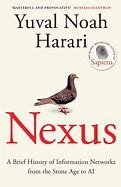
In this next “chapter” of a series of books that started with Sapiens and attempts to explain history with an eye towards defining certain concepts of storytelling and fictions and how they attributed to the evolution of our species, Harari takes on information. He defines information as a key component in the social expansion of humanity and is careful to expose it for what it is– a means to achieving power. Information, he states, does not equal truth. A naive way of looking at the growing access to information, from the record keeping of the Romans, to the printing press, to the internet, is to assume that having more information means having access to the truth, which brings greater wisdom and makes better informed decisions. Rather, information is mostly used to maintain order. This can be good or bad depending on circumstances. Harari gives us plenty of examples where information was used to misinform or dis-inform leaders and populations that led to catastrophic results. And many of these examples given occurred long before the internet. I won’t get into specifics here for a couple of reasons. One, I’d spoil the fun for you finding out for yourself, and Two (more importantly) I couldn’t give justice to the topics the way Harari does.
That is one of the main purposes I have in recommending Harari’s works. He is just a really good writer who makes history fun. The importance of this cannot be overstated. I read this book at the same speed I would read a riveting fantasy epic or an exciting sci-fi tale. It was that engrossing and just plain fascinating. Harari doesn’t give us the same old examples of history, with the same old explanations. He digs up stuff I’d never heard about. He focuses on things that had massive effects on the course of history that other history books either gloss over or miss completely.
Harari spends a lot of time focusing on Democracies and Authoritarians, both their differences and how closely related they can be. He points out that these things are not polar opposites and are quite malleable dependent upon the use of information. He points out that the constitution of the United States is a very important document because of the built in means of self-correction. Unlike the bible which presents as infallible, the constitution recognizes that it was created by fallible humans and should be adjusted accordingly. For instance, the constitution was able to be amended to ban slavery whereas the bible cannot be (according to the misinformation of certain authorities, that is). Once again, Harari explains these things much better than I can.
The elephant in the room is Artificial Intelligence, or as Harari prefers, Alien Intelligence. He gives us a long explanation about why he prefers this term. The best I can boil it down to quickly is that artificial has a connotation of something fake or lesser and something created that can be controlled. Alien denotes something we don’t fully understand and may be already out of our control. The advent of AI is quickly moving into alien territory. The algorithmic control that AI is beginning to display over the everyday lives of humans is a very concerning topic for Harari. He explores this with plenty of examples of the testing and researching that has been done at places like Google, Meta, and Amazon. The third part of the book really explores what AI can mean for our future and lays down a cautionary tale that really should be heeded, but will probably be ignored by our current leaders. He cautions us that algorithms are currently programmed to increase exposure and profit over truth, rather than being programmed to disseminate and sort information reliably. This way, information that is exciting, bombastic, and attention getting, even if completely false, brings in more exposure, therefore more profit, than it would if it was checked for accuracy. Self correction is not built into these algorithms. So until humans can self correct, any false narratives have maximum exposure if sensational and believable. The main goal of AI is to connect rather than represent.
All that said, Harari does relent that we cannot be too cynical about AI so that we swing to far in the other direction. As much as information prefers order over truth, no system can survive indefinitely on falsehood (that is; Nazism, Stalin-ism, the Spanish Inquisition, etc.). He does present hope that humans as individuals naturally seek truth over order in the long run.
I marveled at Harari’s ability to convey concepts in an entertaining and informative manner. I hope you will too.