
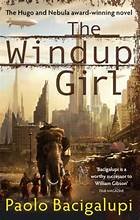
THE WINDUP GIRL by Paolo Bacigalupi

Imagine a future that creates a working elephant from the lost DNA of a mammoth and improves on that DNA to have the mammoth be completely domesticated. Creating energy and possibly reducing workload for humans. Imagine creating vats of engineered food stuff in order to feed a growing populace. Imagine the invention of a technology that relies of spring motion power (or something like that, I don’t understand the science at all), to run devices without the need for carbon based fuel or electricity. You might think this future was some sort of idealized utopia where poverty is struck out and the planet is run efficiently. You might think this future is something to strive for.
Wrong! The future of Bacigalupi’s novel is dark, dystopian, and not a place we want to live. The novel thrusts us, kicking and screaming, three hundred or so years into a future that has been devastated by flood, famine, and disease. A future where the apocalypse came and went on its merry way, leaving behind a crumbling infrastructure to pick up the pieces and carry on with the harsh task of living. It is a bleak future of resource management. Beyond this grim reality, Bacigalupi tightens his focus on an interesting cast of characters embroiled in the day to day life in the Kingdom of Thailand.
These character interactions are essential to understanding the society built up here, as they come from all different walks of life and serve to build the setting as much as the descriptions do. We get thrust into a confusing array of vocabulary that uses borrowed phrases from various South East Asian languages as well as invented slang that relies a lot on inference. The isolationist policy of the Kingdom directly relates to the attitudes and concerns of the main characters, whether they are a product of such nurturing or are trying to penetrate the bubble.
Bacigalupi makes fantastic use of various religions, integrating many of them into a sociological smorgasbord of gods, spirits, and theologies. He deftly intertwined the characters’ views on various philosophical aspects with the realities of a harsh life. This allows the locals to take what they need from Buddhism, Hinduism, and other religions to suit their spiritual needs. Ancestor worship is also an important factor and even the recently dead can be worshiped as a god or spirit.
So with this amazing set up, what does the book do for us? The story slightly suffers from over set up. There were many instances where I was waiting for something to happen and was stopped short by more society building and philosophy. The purpose for the introduction of the title character, The Windup Girl, took quite a long time to develop. Be prepared as there are a couple of very brutal assault scenes involving this character that may be a bit much to handle.
Minor quibbles aside though, Bacigalupi brings it all together in a very satisfying manner. The narrative twists and weaves in tandem with the politics, and seemingly random events have long lasting ramifications. Some of the themes he plays with are harmful environmental changes, identity issues, and social status of a new type of being. A conscious being created by mankind. Important questions are raised as to what kind of rights such a creature has. Are they a danger to society or the whole human race? Should we make more of them? What responsibility does a god have for its creation? Deep thoughts and questions with no easy answers.
Overall, if you like dystopian futures, you’ll very much enjoy Bacigalupi’s unique take on a future that is not at all out of the realm of possibility.
Leave a Reply
You must be logged in to post a comment.