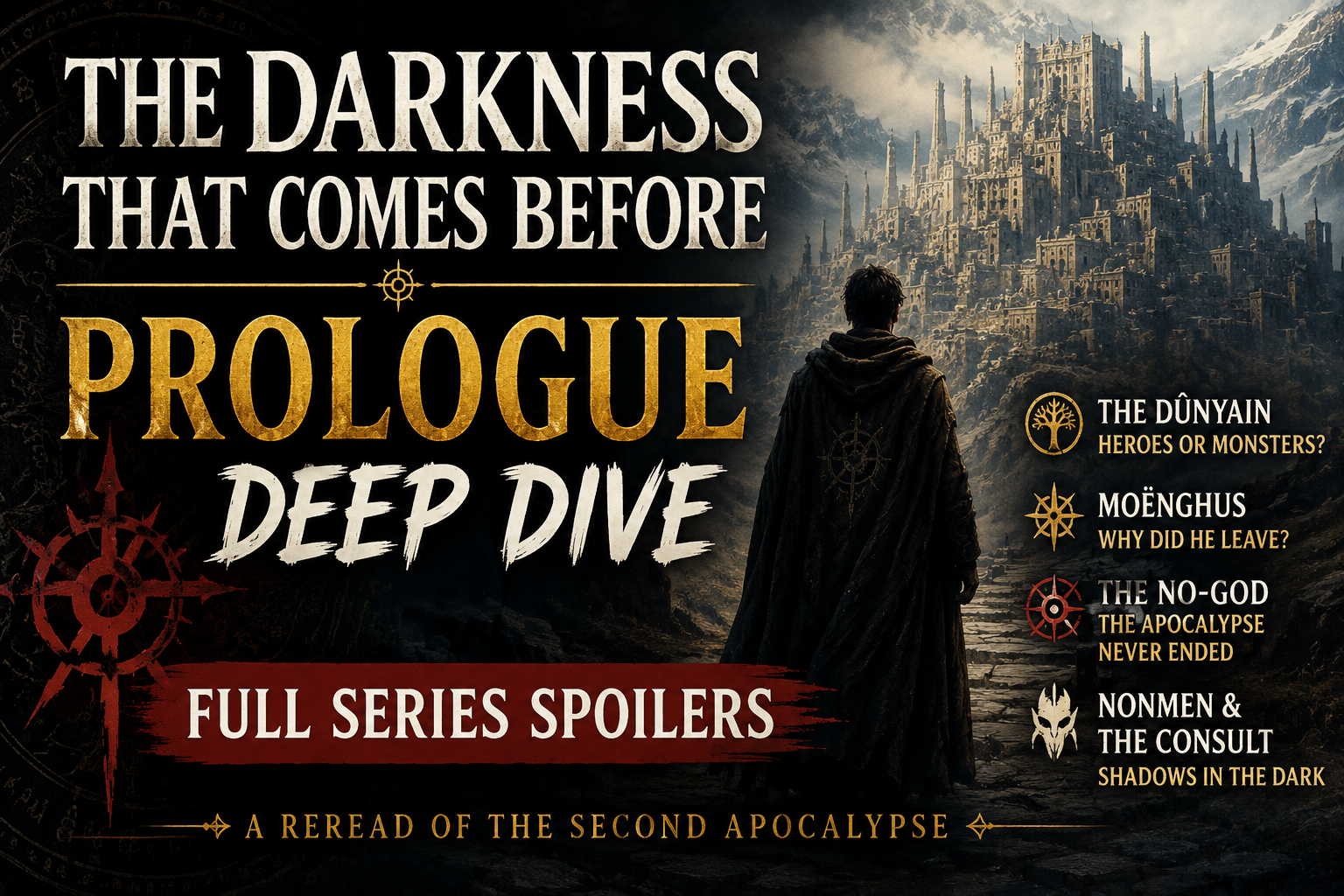
The Darkness That Comes Before Reread: Prologue Discussion (Full Series Spoilers)

Early Access for supporters of the Page Chewing blog, episode will be public Saturday 7/4.
When readers first pick up The Darkness That Comes Before, it’s easy to see the prologue as little more than an introduction to Kellhus and the mysterious Dûnyain. But after finishing The Second Apocalypse, returning to those opening pages reveals something remarkable: almost every major theme, conflict, and revelation in the series is already there.
In this episode of our spoiler-filled reread, we spend nearly an hour discussing just thirty pages and somehow still feel like we’ve only scratched the surface.
A Story That Begins at the End
The prologue doesn’t simply introduce the world of Earwa. It opens in the shadow of the First Apocalypse and quietly reminds us that history never truly stays buried. The Consult, the No-God, and the consequences of forgotten wars all linger beneath the surface long before the main story begins.
On a first read, these details feel like background lore.
On a reread, they become impossible to ignore.
Is Kellhus Already the Villain?
One of the biggest questions we explore is whether Kellhus is already the antagonist from the very beginning.
His interactions with Leweth reveal many of the traits that define him throughout the series: observation, manipulation, emotional detachment, and an unwavering commitment to achieving his goals. Knowing where his story ends completely changes how these early scenes read.
We also discuss whether the Dûnyain philosophy represents enlightenment or simply the perfection of manipulation.
Hidden Foreshadowing Everywhere
One of Bakker’s greatest strengths is how confidently he hides enormous reveals in plain sight.
During our discussion we touch on:
- The significance of Moënghus leaving Ishuäl
- Early references to the No-God and the Consult
- The first appearance of the Nonmen
- The symbolism behind “One cannot raise walls against what has been forgotten.”
- Whether the gods are already influencing Kellhus
- The introduction of determinism and the Logos
- How much of the ending is already encoded in the opening pages
Even details as small as a single word or description seem to carry new meaning once you’ve completed the series.
Why This Reread?
This reread is designed specifically for readers who have finished both The Prince of Nothing and The Aspect-Emperor.
Rather than avoiding spoilers, we’re embracing them. Our goal is to examine the series through the lens of everything we now know, uncovering the clues, themes, and philosophical ideas that are easy to miss the first or even second time through.
Whether you’ve read the series once or several times, there’s always another layer waiting to be discovered.
Join the Discussion
Do you think Kellhus is already the villain in the prologue?
Is the Dûnyain philosophy a path to truth—or simply another form of control?
What details did you notice on your reread that you completely missed the first time?
Leave a comment below or join the discussion on the Page Chewing forum. We’d love to hear your theories as we continue our spoiler-filled journey through The Second Apocalypse.
Happy reading, and we’ll see you for Part II next week.

Tags: Achamian, Anasûrimbor Kellhus, Book Club, book discussion, book podcast, Consult, determinism, Dûnyain, epic fantasy, fantasy analysis, fantasy books, fantasy discussion, fantasy literature, fantasy podcast, free will, grimdark fantasy, Ishuäl, Kellhus, Logos, Moënghus, No-God, Nonmen, page burners, page chewing, philosophical fantasy, prince of nothing, R. Scott Bakker, reread, Spoiler Discussion, The Darkness That Comes Before, the second apocalypse
Leave a Reply
You must be logged in to post a comment.