Guest Post: From Rainbow to Hell: What Ten Years of Writing a Dark Fantasy Saga Did to the Story, and to Me

Author bio:
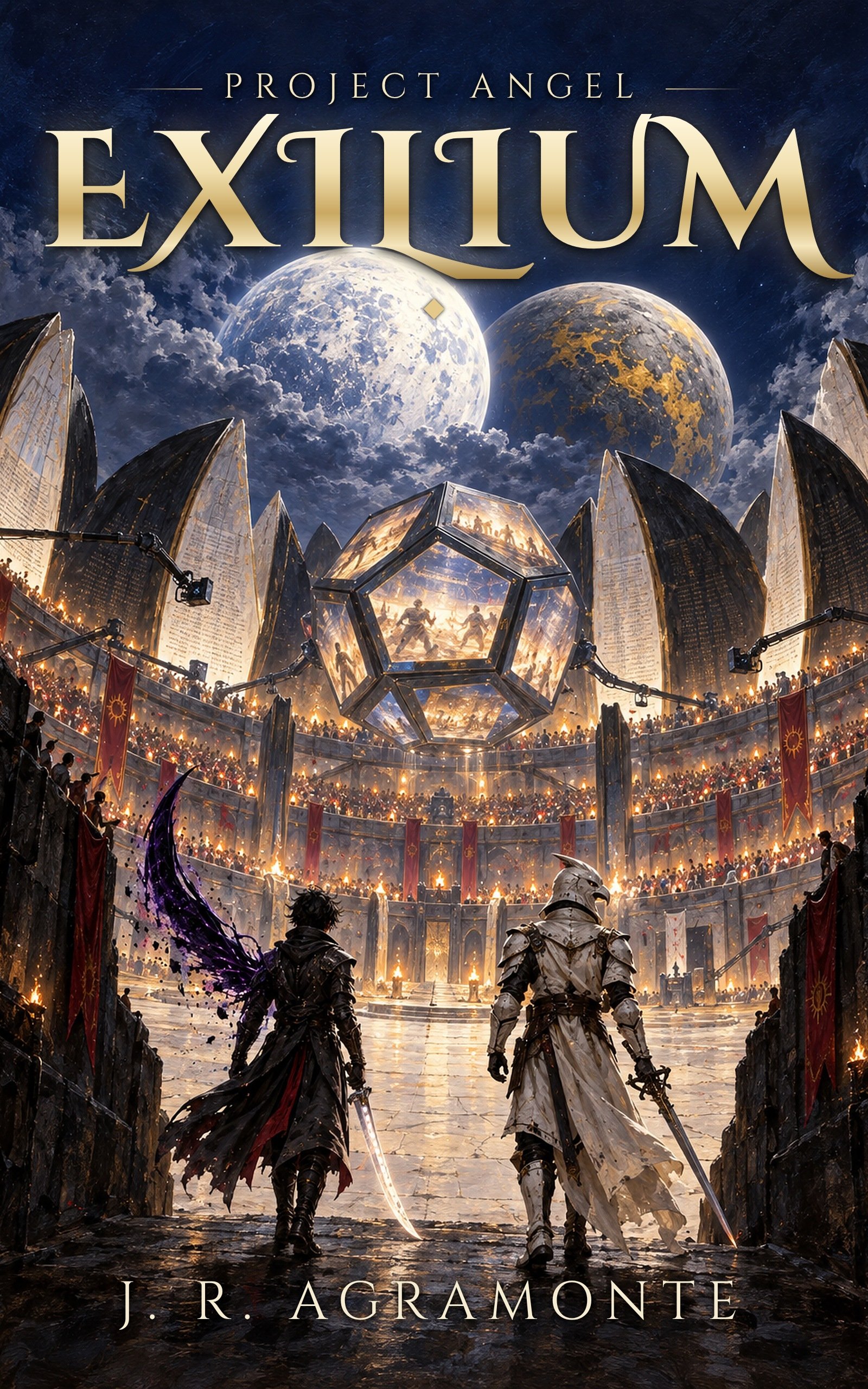
J. R. Agramonte is the pen name of Javier Rodríguez, a Cuban writer living in Abu Dhabi. He spent ten years building the dark epic fantasy saga that begins with Exilium, his debut novel. He writes in Spanish and English, and when he isn’t writing he works behind the bar.
I’ve always liked gore within the quiet. Darkness when you least expect it.
I found a lot of it as a teenager, with a controller in my hands. Final Fantasy VII, VIII, IX and XIII. Tales of Symphonia and Tales of Vesperia. Zelda: Twilight Princess. Everything in those worlds is colorful, the music is quirky, the characters look like they came out of a cartoon, and then, suddenly, one of those cartoonish characters is suffering, or dying, right in front of your eyes.
Blood in a horror movie gives me nothing. I expect it there. But a delicate, kind princess having her arm torn off in cold blood? That is the kind of scene, the kind of plot twist, I love to read. And it’s the kind I love to write. Every time I put pen to paper, I hope to go from rainbow to hell, and to take my readers on that journey with me.
Never expect things to go your way
In my book, you can never expect things to go your way.
When I was sixteen, I nearly drowned off the Malecón in Havana. I was going down. I had already accepted that I was done: my muscles weren’t responding and my mouth was full of salt water. And somehow I found strength. I had my anime moment, and I came out of a very rough sea, even though I’m not the best swimmer.
So I don’t fear death, even though I love life. The most painful heartbreak, cruelty, all of it feels small compared to accepting that your life is ending and watching the world you love fade in front of your eyes. So I use those things, and the reader needs to be ready for pain.
No, I don’t kill characters like Game of Thrones. Death is too simple, too quick, too easy. I take my characters, and my readers, through much worse. Look at Lídel: his desire to be glorious and famous turned into a sad joke, his arrogance into humiliation. And I’m just getting started.
What ten years did to the story
Over ten years, I came to understand love and sex in a depth a teenager can’t even imagine. Politics too, and the game of power. All of that altered the tone of the story.
No one changed more than Cera, by far my favorite character. She is a representation of a very interesting woman I met, one with a very kind soul yet completely submerged in darkness. But she also represents a very deep side of myself: intelligent, brave, determined, careless. Over the years Cera kept evolving: her sexuality, her habits, her language. She’s one of those people you want to hate but can’t. She fascinates me because she and Lídel are two sides of the same coin, and together they help me explore just how far ambition can take us.
The ugly kid
Something that completely changed me was my place in society. I didn’t choose it. For most of my childhood I was the ugly kid in the classroom. Bullying and mockery were my every day in Cuba, and because the educational system there is so broken, my teachers were too young and too careless, and sometimes they laughed at the jokes thrown at me too. My high school history teacher humiliated me more than once for my looks, in front of all my friends, and in front of the girl I was in love with for years and never had the courage to tell. (She’s Mila, in Exilium.) I never cared much about my appearance. I was more focused on the possibility of getting a letter from Hogwarts than on my hairstyle.
The guys from my street were no better. I was the weirdo who never left the house, always reading and playing video games they found boring because they weren’t FIFA or Call of Duty. Since they never saw me with a girl, they decided I was probably gay.
And then, for some reason I still don’t understand, everything shifted. Suddenly they saw me walking past them with beautiful, interesting women. The weirdo became popular. I let myself go: from the quiet ugly kid to hanging out with drug dealers, from 0 to 100 very quickly. The shy nerd suddenly had more attention than he knew what to do with.
But deep down I was still the shy kid. I still think the best day is one spent alone in a dark bedroom with all the digital entertainment I can get my hands on. Just to prove something to them, and especially to my dad, I became the opposite of what they judged me for: the dancer, the Cuban bartender a lot of people wanted to sleep with, the best party mate you could find. In my twenties I slept around so much I lost count, and even though I was always a very loyal friend, I wasn’t the kind of person you wanted your daughter to date or your son to hang out with. Now, in my thirties, I’ve found balance again.
And Lídel is all of that. Exilium is only the beginning of his journey. He is still naive, hopeful, in love with love and fairy tales. But after what happens in Xactos, he starts a ride not many can handle.
What ten years did to me
I was lucky, or maybe unlucky, to live love stories of every kind: from the most beautiful, high-school-American-movie type to the most intricate, crude and dark romance, the kind that only belongs in places like Havana.
Then I got into tourism in Cuba. I had conversations and went for drinks with people from every culture and religion. Then came Dubai, and the bar: the late talks in places where you’re making mojitos for the 1%, and, better still, for the people around them. Because the ones with the best stories are never on the cover of a magazine. They can’t be, even though they desperately want to.
The door that never opened
I’ve been in love with literature all my life, but I’ve never found my place in our guild. Publishers said no, so many times I lost count. Agents too. “You’re too young.” “Your book is too long.” “You need to add more romance, because that’s what sells right now.”
So I became my own publisher. My own marketer. Even my own translator. Luckily, I found amazing, talented people along the way who helped me refine my work and gave me hope.
Everything or nothing
I found my faith when I was twenty-six, after making fun of religion my whole life. I had an experience of connection with something I couldn’t understand. I got into the Yoruba religion and found out I’m a son of Shango, the orisha of thunder, war and passion. I also found out that the lore of our religion is strikingly similar to the Big Bang theory. Being so passionate about both science and creation stories, I ended up loving my religion, and I decided to honor it, and explore it even more, by making it the mythology behind the Project Angel saga. That’s why, in my world, the Creators are called Eshu, Oloddumare and Yemayá.
So for me, this is everything or nothing. I owe it to my characters and my world: they don’t deserve to die in a drawer. I owe it to everyone who ever gave them, and me, a chance. And above all, of course, I owe it to myself.
Leave a Reply
You must be logged in to post a comment.