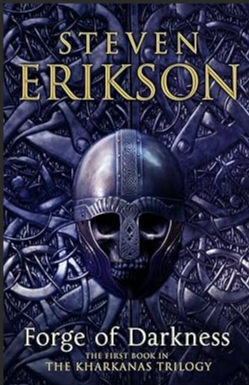
FORGE OF DARKNESS by Steven Erikson

Forge of Darkness is the 1st book in the Kharkanas trilogy written by Steven Erikson. There are currently only 2 books out in this trilogy with the 3rd one being worked on as of this taping. Keep in mind that the word trilogy is merely a place holder with Erikson, and that things could change in the future.
Make no mistake, Forge of Darkness is through and through a Malazan book. Although it doesn’t take place on the same world, the events in here echo through the eons and have direct correlation to The Malazan Book of the Fallen and Esslemont’s Novels of the Malazan Empire.
But, do not mistake this book as “more” Book of the Fallen. It is not. Erikson does us the great favor of changing up his style, changing up the structure, and making this world feel as new as possible without creating a whole new universe. Structurally, he does away with epigraphs and with splitting the book into different parts. He does away with a prologue and epilogue, instead just giving us a small prelude to introduce us to the storyteller (more on him later.) Stylistically, Erikson gives us a more rhythmic cadence. The sentence structure almost has a beat to it. It lends itself to being spoken aloud. Like a play. The way the characters are introduced in each scene has a “scene setting” quality to it. You can almost picture the stage notes, Enter, stage left, Anomander. The way the scenes are set up, you rarely have to keep track of more than one character at a time. That’s not to say there aren’t a ton of characters in here. There are, and you’ll find yourself flipping back to the Dramatis Personae several times if you’re the type of person who has to keep track of these things. But the way the book is written and the structure of the chapters made it easier to keep track of who you were following. The chapters are long, but they usually began and ended on a solid thematic note, and mostly ended with the same characters you began with, albeit plenty of jumping around in between.
The story is a tragedy. You may think that is similar to The Book of the Fallen, but it’s not. Forge of Darkness does not have the underlying sliver of hope that The Book of the Fallen subtly layers into the narrative. At least this far into the trilogy, hope is trampled on and left to die in the bitter recriminations of a civil war. Like much of Erikson’s writing, he does not hold back when detailing the horrid things people do to each other. These things tear at the reader and make one want to seek revenge or wallow in grief just as much as the characters on the page. Revenge and Grief are the names of a thematic balance winding through the story. One weighs heavier than the other at different times, but both are tragic in their need to shatter innocence. One thing to remember is that any information through tales told in the Book of the Fallen, is just that, a tale. A story told through the lens of history, but history through speculation, conjecture, and unreliable narration. With the Kharkanas trilogy, Erikson is reminding us that history is an ongoing debate, a discussion, an argument even, and not a permanency. The Book of the Fallen is merely a tale told, and not history.
The tale we are getting now, is told through the eyes of the poet Gallan. He who is briefly mentioned in The Crippled God as a court fool. So how much of this narrative can we trust?
You know what? Don’t worry about it. The tale will strike you as it will, and if you like Erikson’s prose and style, you will no doubt enjoy this book.
Can you read this book without having read any other Malazan works? Technically, yes. There are quite a lot of sections where names get dropped that emote a certain sense of awe for those in the know. But one could wander through the tale oblivious to the context of future events and get out of the book a basic tragedy of a society on the brink of eminent collapse. I wouldn’t recommend it though. There’s too much fun to be had with the recognition of characters and names we’ve already come to know.
Keeping in mind that this is a first book in a trilogy, the end of this book sets the stage nicely for things to come. This is mainly a set up book. It presents the players, the stage, and the conflict. Very simple barring the fact that the language used is a complex combination of poetic verbiage and articulate subtly. It’s quite fun to parse through the words, break them down and seek the basic meaning. Necessary to enjoy the story? No. But if you enjoy word play, then fun it is.
Leave a Reply
You must be logged in to post a comment.