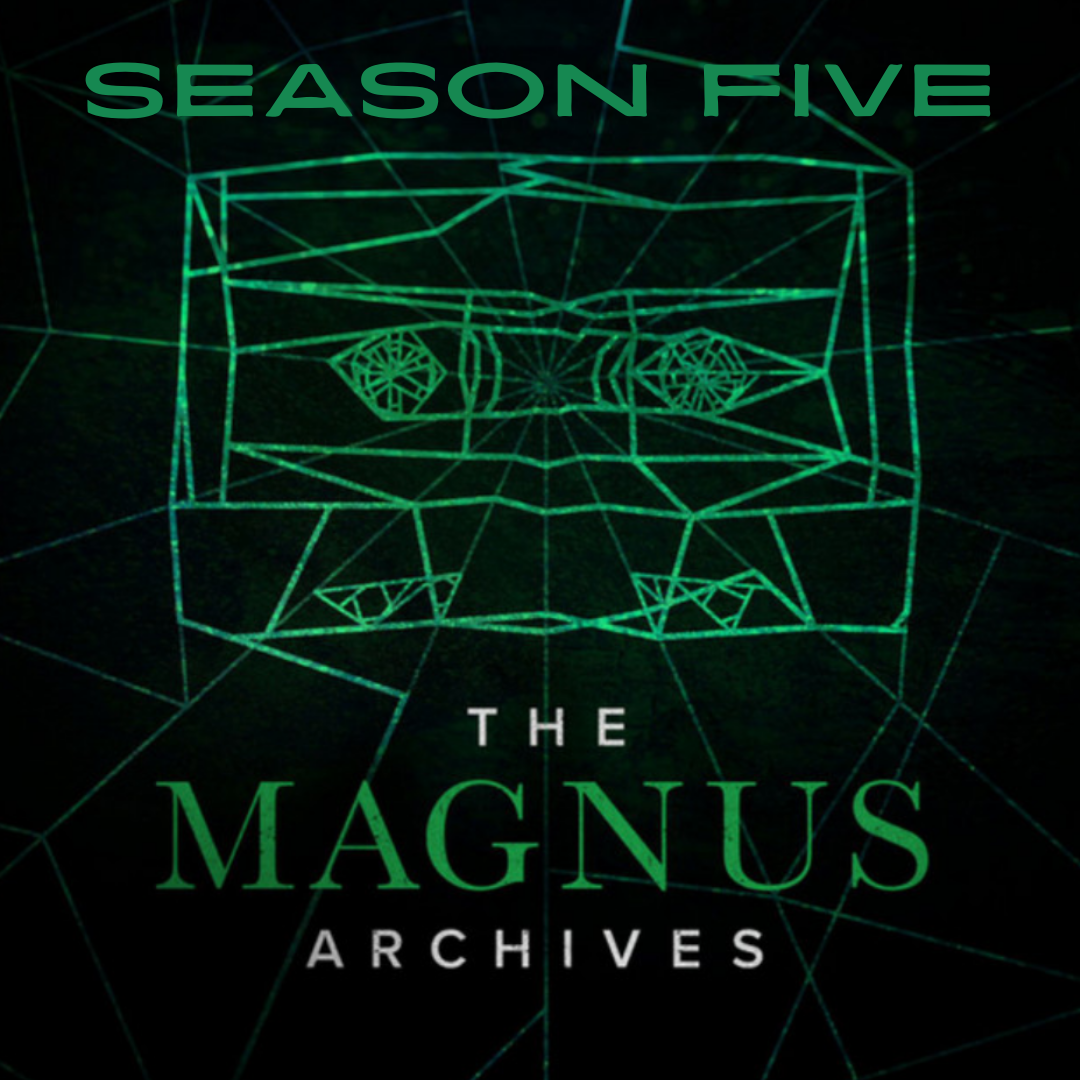
The Magnus Archives Season Five by Jonathan Sims

“No reason to not live the apocalypse in style” – Mikeale Salesa, Episode 181: Ignorance
We’ve come to the end of this incredible show. As I wrote this review I was still processing what I thought, and it’s taken a few attempts before I felt like I had my thoughts sufficiently in order to write something cogent. Before I continue, please note this review contains major spoilers regarding the ending of Season Four. If you haven’t yet listened to those episodes then please do so before continuing to read this post, and if you’re new to the whole thing then check out my review for Season One.
When I first began reviewing The Magnus Archives for Page Chewing, I mentioned how the show became something of a phenomenon. Part of the reason for that was as the fifth season was being released during 2020-2021 the world was in the grip of the COVID pandemic. People were unexpectedly stuck at home with plenty of time on their hands and at the start of 2020 there were 160 very bingeable episodes waiting to be listened to from the first four seasons.
COVID was therefore an opportunity for the show, but it was also a defining moment for the team at Rusty Quill who were behind the production. The COVID restrictions presented an enormous number of technical and practical challenges for the cast and crew alike. The Magnus Archives had always been a show where each episode was written, recorded and released in very short order. That process was difficult to manage in lockdown, resulting in a story-arc structured in three parts which allowed everyone involved to take a break.
Special thanks are due to the writer, Jonathan Sims, director Alexander J Newall, producer Lowri Ann Davies and editor and soundscape designer Elizabeth Moffatt. That they were able to put out a show at all in such circumstances is testament to their incredible dedication. However, the fact they produced something of this quality is nothing short of miraculous.
Whilst that praise is very much due, I did have some issues during the opening episodes, and this is where that huge spoiler comes up. Starting a series following the end of the world is not ideal. Whilst the reveal at the end of Season Four concerning the Head Archivist’s true purpose was an incredible twist, the outcome was a world transformed, with all the fears fully manifesting in the real world to rule over a series of hellish domains.
This means we are plunged into a series of episodes where the horror is unrelenting and present from the beginning. Whilst written with incredible imagination, there’s a curious lack of tension at the start of Season Five. Horror works best (for me, at least) when there is that creeping sense of dread that something is not quite right. The tension comes where it subtly intrudes on the real world, and at some point you cross the threshold from normality into horror, with an accompanying sense of unease and jeopardy for those involved.
The hellscape world plunges everyone into a realm of horror from the start, changing the format and essence of the show. We move into an analogue to Pilgrim’s Progress, with Jon and Martin undertaking their own pilgrimage through a landscape of horror. Yet they are more than just mere bystanders or, if you’ll forgive the pun, observers. The fulfilment of the Watcher’s ritual has given Jon real power in this world. It gradually dawned on me there was an underlying tension, centring around what was going to happen to Jon and Martin when they finally faced Jonah Magnus and the Watcher.
The sound production throughout also helps draw you in as the listener and keeps you engaged. There’s always so much going on at the edge of your hearing, helping set the scene, convey a sense of space or confinement and indicating the terrible otherness which has befallen this world. Elizabeth Moffatt deserves all the plaudits for how well Season Five works in this regard as an immersive experience.
Once I was settled into this new format and the shift in the power dynamics I became fully invested once more. Sim’s writing remains top notch and looking at my notes there were so many standout episodes. I personally preferred moments when we could take a step back from the hellscape, since this brought things into sharper focus. Examples included hearing old tapes featuring former cast members in Episode 162: A Cosy Cabin or Episode 181: Ignorance, which is one of my favourites. A couple of others to highlight include the poetic Episode 166: Revolutions, which has to rank as one of Sims’ best performances, and Episode 186: Quiet, where Newall plays two versions of Martin with great skill and nuance.
The overall concept delivers a greatest hits experience, as Jon confronts many of those evil characters from previous series. The third and final act is particularly enthralling, as we finally discover who is really driving events and Jon and Martin face some difficult decisions. The ending itself proved controversial at the time and still provokes debate amongst new listeners five years after it first released. I’m not going to spoil things by going into the reasons why but for me it worked and was very much in keeping with the show.
I think The Magnus Archives would definitely reward a re-listen, simply because there’s so much that only becomes clear later on. It would be fun to listen to those episodes knowing the connections this time round and appreciating just how well all of this was plotted right from the start. The ‘found footage’ nature of The Magnus Archives gives it a timeless quality, so if you haven’t already listened to the show (and for some unfathomable reason carried on reading this review despite the massive spoiler warnings) then do yourself a favour and give it a try.
It took me around a year to listen to all five seasons and during that time these wonderful characters have seeped into my consciousness. Now it’s over I feel bereft of their company and at a loss for what to do next, which is the hallmark of a brilliantly written show. I’m still amazed this team had such vision from the outset, maintained such a high level of quality throughout 200 episodes and brought the show to a satisfying conclusion. The Magnus Archive truly was something special.
Leave a Reply
You must be logged in to post a comment.